
Differential Gear System
A differential gear system is a crucial mechanical component in automotive engineering, designed to distribute torque to the wheels while allowing them to rotate at different speeds. This function is essential, especially when a vehicle turns, since the outer wheel must travel a greater distance than the inner wheel. Without a differential, tires would slip, steering would be unstable, and mechanical stress on the drivetrain would increase significantly.
Core Functionality
At its core, the system consists of a set of bevel gears enclosed in a housing, connected to the drive shaft and axles. When driving straight, the gears rotate together as one unit, transmitting equal torque to both wheels. During a turn, however, the differential allows each wheel to spin at different speeds while still receiving balanced torque.
Applications in Vehicles
- Automobiles: Standard passenger cars use open differentials for efficiency and smooth handling.
- Trucks and Off-road Vehicles: Limited-slip and locking differentials provide additional traction on uneven terrain.
- High-performance Cars: Torque-vectoring differentials enhance handling and stability at high speeds.
Key Advantages
- Improved maneuverability during turns
- Reduced tire wear and drivetrain stress
- Enhanced safety and driving comfort
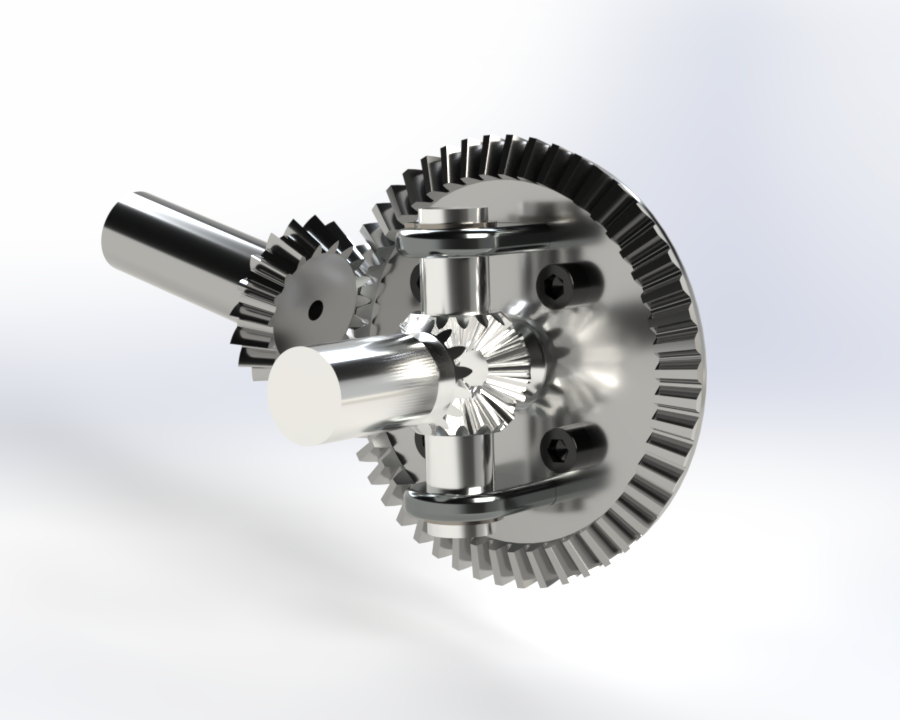
- Differential gear system or standard open differential using bevel gears.
- Key components of the design go as follows:
- An input pinion gear mounted on the input shaft.
- A large ring gear which meshes with the pinion.
- A differential carrier (or cage) that is attached to the ring gear and rotates with it.
- Planet gears mounted on a pin within the carrier.
- Two side gears (sun gears) that mesh with the spider gears and are connected to the output shafts.
The mechanical arrangement is designed to transmit torque from a single input source to two independent outputs, allowing them to rotate at different speeds. The input pinion drives the ring gear, which in turn rotates the entire carrier assembly. The spider gears then transmit this rotation to the side gears. When turning, the spider gears can rotate on their own axis, enabling one side gear to speed up while the other slows down by a corresponding amount, all while continuously delivering torque to both outputs.
Find more on Mechanical Library.
You must be logged in to post a review.
Reviews
There are no reviews yet.